Start here
AI Act and C2PA: how transparency is changing for AI-generated content
The AI Act requires machine-readable marking for AI-generated content. Learn how C2PA, watermarks, labels and Content Credentials fit together.
Read the guideUnderstanding digital trust
Fake news, fact-checking, C2PA and blockchain notarization. Guides to checking sources and context, understanding digital evidence and publishing content with accessible provenance.
The AI Act requires machine-readable marking for AI-generated content. Learn how C2PA, watermarks, labels and Content Credentials fit together.
Read the guideEuropean obligations, marking and provenance for synthetic content.
The AI Act requires machine-readable marking for AI-generated content. Learn how C2PA, watermarks, labels and Content Credentials fit together.
Check news and prevent misleading sharing.
A checklist for preventing fake news through source, date, image and corroboration checks, with corrections that do not turn uncertainty into certainty.
Assess news sources through lateral reading, original documents and independent evidence, with a practical example and an evidence record.
Learn how to check an out-of-context photo through reverse search, chronology and caption comparison, and why a real photo can support a false story.
How to assess a possible deepfake using the source, full recording, audio and context while accounting for the limits of AI detectors.
A process for businesses and press offices covering official sources, editorial checks, file versions and corrections that make published material verifiable.
Understand the standard and read credentials.
Learn how C2PA works through manifests, signatures and content provenance, with practical examples, blockchain differences and verification limits.
A practical guide to Content Credentials, including signatures, edits, ingredients and verification status, plus what missing credentials mean.
Compare C2PA, visible and invisible watermarks, fingerprints and hashes: what they check, how they can work together and what a pilot should test.
How to use C2PA with AI-generated or edited images through claims, captions, versions and checks, and why a valid signature does not prove a real scene.
Distinguish clues from evidence.
A method for verifying an online image: find its source, read C2PA data, check the context and understand the limits of AI image detectors.
How to read photo EXIF metadata such as dates, camera and GPS, and how it differs from IPTC and C2PA data when the original file is unavailable.
C2PA credentials missing or unreadable? Diagnose errors, unsupported formats and file transformations from the CMS to the public download.
Digital fingerprints, versions and evidence over time.
Learn what a document hash is and how to calculate SHA-256 on Windows, macOS and Linux, with version comparisons and signature differences.
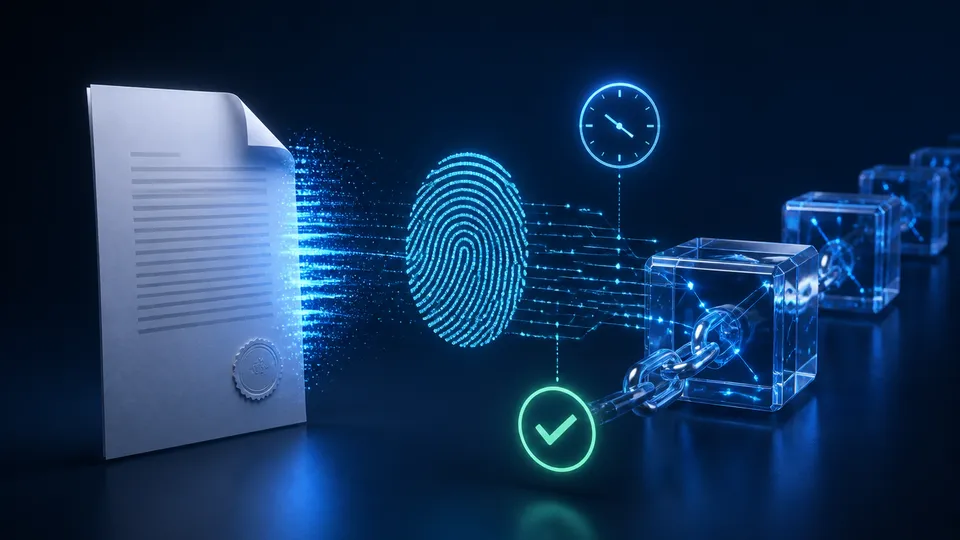
How blockchain document notarization works through hashes, records, verification and retention, including what the proof establishes and its limits.
How to check a PDF against an official copy using hashes, signatures and revisions before attributing a difference to manipulation.
Bring verification into publishing workflows.
Design a CMS workflow with C2PA, APIs and verification badges across assets, versions, signing, CDN delivery, corrections and release checks.
Organize a press room around sources, versions and verifiable proof, with practical guidance for images, PDFs, asset records, downloads and corrections.