Blockchain document notarization: what it proves and how it works
How blockchain document notarization works through hashes, records, verification and retention, including what the proof establishes and its limits.

Blockchain notarization of a document links the cryptographic fingerprint of one version to a record on a distributed ledger. Its technical purpose is to enable a later check: does the file presented today match the recorded fingerprint?
This concept is useful for reports, certificates, and content intended to circulate over time. To use it correctly, distinguish the document from its fingerprint, registration from storage, and integrity from the truth of the information.
The document and the proof are different things
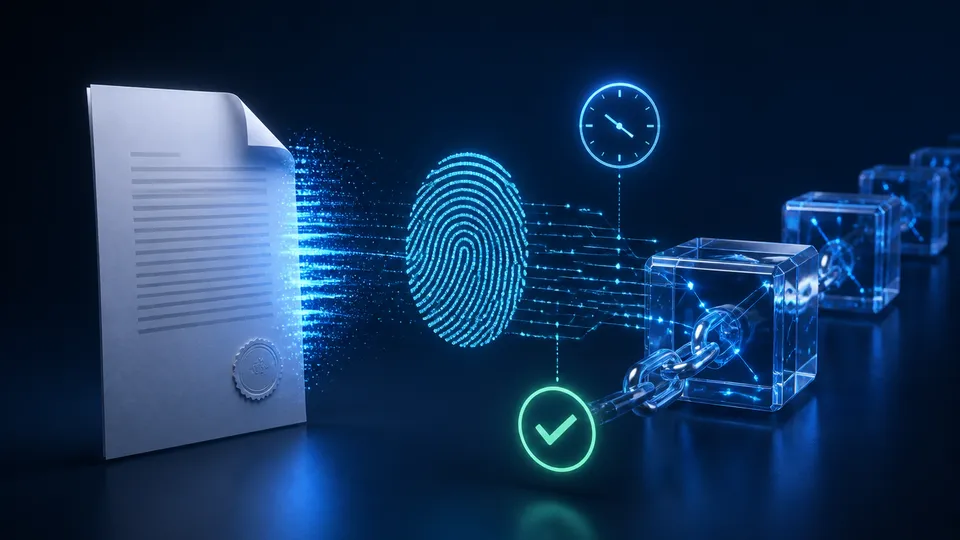
In a hash-based architecture, the document remains in the system that stores and distributes it. A fingerprint, or a value representing it together with other fingerprints, is anchored to the ledger. The original PDF or image does not need to be uploaded to the blockchain.
The document hash is calculated from the file's bytes. If the version changes, a new reference must be created. The file name alone does not identify the version: two documents called report.pdf may have different fingerprints.
Here, “notarization” describes this technical process. It does not automatically imply the involvement of a notary or a particular legal effect. If the project requires legal effects, they must be assessed separately from the technical architecture.
How the process works in five steps
- Define the version. Approve and finalize the document, including any transformations that could change its bytes.
- Calculate the fingerprint. The system uses a stated algorithm, such as SHA-256, and associates the result with the document and version identifiers.
- Record the reference. A transaction anchors the value to the selected ledger. If several fingerprints are aggregated, the process must also retain the data needed to prove inclusion of the individual fingerprint.
- Wait for the required result. Submission, inclusion, and finality are different states. The completion criterion depends on the network and process used.
- Retain what verification needs. The file, algorithm, fingerprint, and proof references must remain retrievable, together with any verification instructions.
Ethereum's pages on blocks and transactions illustrate how one public ledger works. Choosing another network requires checking its specifications; blockchains do not all have the same timing, costs, or finality mechanisms.
What notarization proves
The result should be described precisely. Useful proof links a fingerprint to a verifiable record, but it does not automatically make every claim in the document true.
| Question | What must be checked |
|---|---|
| Is this the file linked to the proof? | Recalculate the hash and match it to the attested value |
| Does the record exist? | Check the network, transaction, result, and actual link to the fingerprint |
| What point in time does it refer to? | Read the ledger's time reference and properties without confusing it with the file's creation time |
| Who wrote or approved the document? | Identity, signatures, and organizational process: a hash alone is not enough |
| Is the content accurate? | Substantive checks of the information, separate from the record |
Even when the record is valid, it does not prove the file was created at that exact time; the document may have existed earlier. A blockchain timestamp should not automatically be presented as a qualified electronic time stamp.
How to verify a notarized document
Start with the original copy you want to check. A scanned printout or screenshot produces different bytes and cannot be compared directly with the source file's fingerprint.
Then retrieve the proof. It should at least state the verification method and the references needed to connect the document to the record. A transaction number alone may not be sufficient if you do not know where and how the fingerprint is encoded.
Recalculate the hash with the stated algorithm and verify the connection to the record. In systems that aggregate fingerprints, also check the inclusion proof. Finally, read the record's status under the rules of the network: a pending request is not completed proof.
The verification report should distinguish at least three outcomes: confirmed match, mismatch, and check could not be completed. A temporarily unreachable network does not prove that the document is fake; it means the check was not completed.
Storage and versions: the part you should not overlook
A record cannot recover a lost document. The organization must retain the exact copy and be able to export the material needed for verification. Test the process periodically with a copy downloaded from the public channel, rather than only with the file on the server.
Consider a certificate updated to correct a detail. The corrected certificate has a new fingerprint and needs new proof. The old record does not disappear: the publishing system should explain which version is current and why the previous one was superseded.
When designing the process, first decide who approves an update, how the version is identified, and which page someone following an old link will see. These decisions make the proof understandable even to people who do not regularly use blockchain tools.
How it connects to C2PA and the verification badge
C2PA defines a model for associating signed provenance claims with an asset. A blockchain anchor instead links to an external ledger. A project can use both, provided the interface explains which checks were performed and on which object.
The badge is an entry point to this information. It should lead to the correct version, show the available status, and make the scope of the proof clear. On its own, it cannot turn a web page into verified content. The CMS integration guide explores this connection. To add it to your tools, notarize from WordPress or Salesforce with dedicated plugins.
Frequently asked questions
When proof accompanies a public document, the check should include the downloaded PDF version and the way corrections are communicated in the press room.
Must I make the original document public?
Not necessarily. In a fingerprint-based model, the document can remain in authorized systems. Data published on the ledger still requires careful design: even a hash can be compared with candidate copies of a file.
Does valid proof guarantee the author's identity?
No, not by itself. An integrity check does not automatically identify who wrote the content. Linking people or organizations to claims requires additional evidence and an explicit trust model.
Can a notarized document be corrected?
Yes, by creating a new version with new proof and keeping its relationship with the earlier version clear. The old fingerprint should not be treated as if it also described the new file.
Sources and further reading
Technical and editorial references consulted for this guide. Examples are illustrative and do not document real cases or specific integrations.